
From fresh bread and vegetables to dumplings and construction materials: FlyingBasket’s FB3 transported supplies along routes of more than 10 km, overcoming elevation differences of up to 1,500 metres.
Bolzano, 28 September 2026. One hundred and eighty-nine flights, eight Alpine mountain huts involved and more than 8.5 tonnes transported, including supplies carried up to the huts and materials brought back down to the valley.
The first season of mountain-hut resupply operations using cargo drones in the South Tyrolean Alps is drawing to a close. Following the trials launched in 2025, FlyingBasket, a South Tyrolean technology company operating internationally in the design and development of cargo drones for logistics, has transformed individual experimental missions into a scheduled service covering the entire summer. The project was developed in collaboration with the participating mountain huts and funded by the Asset Management Department of the Autonomous Province of Bolzano.
The service enabled the mountain huts to receive more frequent supplies, with greater availability of fresh products and greater flexibility in planning purchases. FlyingBasket also directly managed the collection of food supplies from local suppliers and, on return flights, the frequent transport of waste back down to the valley, thereby simplifying the day-to-day organisation of the facilities as well.
“This summer’s trial demonstrates how innovation can become a practical tool in support of our mountain huts and the people who manage them every day,” says Christian Bianchi, Councillor for Public Works of the Autonomous Province of Bolzano. “Cargo drones make it possible to ensure more frequent supplies, including fresh products, while at the same time transporting materials and waste back down to the valley, making high-altitude logistics more efficient. It is a project that brings together technology, sustainability and attention to the real needs of our mountain huts, while also highlighting an innovative company that was founded and has grown in South Tyrol.”
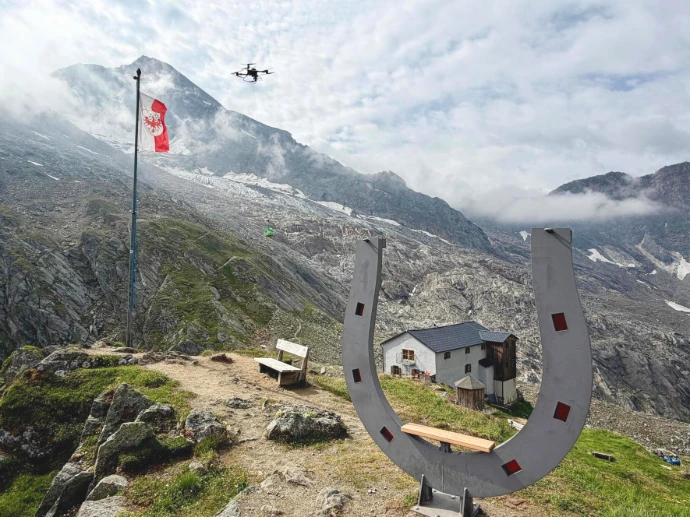
The first systematic season of mountain-hut resupply operations using drones is now nearing completion. It began on 1 June and will end on 13 October, involving eight mountain huts: Payer/Payerhütte, Sasso Nero/Schwarzensteinhütte, Tridentina/Birnlückenhütte, Giogo Lungo/Lenkjöchlhütte, Monteneve/Schneeberghütte, Forcella Vallaga/Flaggerschartenhütte, Vedretta Piana/Grohmannhütte and Gino Biasi al Bicchiere/Becherhaus.
“At first, we were a little sceptical, but after the very first experience we were pleasantly surprised,” says Alain Untergassmair, manager of the Brigata Tridentina/Birnlückenhütte mountain hut. “The operations were well organised, with enough time between one flight and the next to put away the materials we had received, and being able to further increase the payload capacity would allow us to make even greater use of this service in the future. For us, FlyingBasket’s logistical support was also particularly important, as they collected the supplies directly and brought them to the take-off point: a practical help in the day-to-day organisation of the mountain hut. After this experience, it is a service we can certainly recommend.”
Over the course of 32 operations, a total of 189 flights were carried out. The cargo drones delivered 7,078 kilograms of supplies to the mountain huts, while a further 1,491 kilograms of waste, materials, equipment and luggage were transported back down to the valley, making use of the return legs of the missions as well.
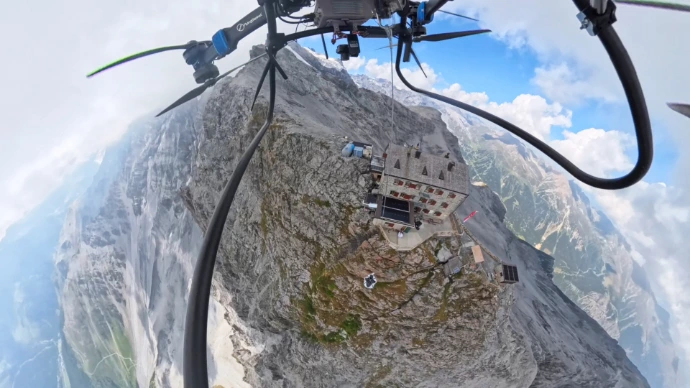
Routes of 10 km and more than 1,500 metres of elevation difference
Each mountain route presented a different logistical challenge. The route to Becherhaus, located at 3,156 metres, extended for approximately 10.7 kilometres and involved an elevation difference of around 1,500 metres. Flights to Payerhütte, at 3,038 metres, overcame an elevation difference of around 1,200 metres, while operations to Schwarzensteinhütte, at 3,018 metres, involved an elevation difference of approximately 1,166 metres.
Throughout the season, the FB3 operated in a wide variety of Alpine conditions, including variable winds, turbulence, low temperatures, clouds and lower air density at altitude. These conditions turned every operation into something more than a simple delivery from point A to point B. The aircraft, communication systems and crews had to operate as an integrated logistics system in one of Europe’s most challenging environments.
The mountains also present a challenge that has little to do with lifting capacity: connectivity. On several routes, the FB3 had to fly around mountains and beyond ridgelines. During some sections of these missions, the terrain made it impossible to maintain a traditional direct radio line of sight between the aircraft and the ground crew. When necessary, Starlink satellite connectivity or 4G mobile networks provided alternative communication links.
In the development of operations such as mountain-hut resupply, ENAC, the Italian Civil Aviation Authority, plays an important role in creating a regulatory framework within which innovative aviation companies can develop and demonstrate new operating models while maintaining the required levels of safety. This collaboration is particularly important for companies developing advanced aviation technologies in Italy and South Tyrol, where the ability to move from technical capability to authorised real-world operations is essential in bringing new services into everyday use.
From bread and dumplings to construction materials
The increasingly routine nature of the service is perhaps best illustrated by the cargo itself. Fresh bread, vegetables, flour, milk, apple juice, water, beer, lemonade, eggs, pasta and meat were transported up to the mountain huts, together with around 200 kilograms of frozen dumplings.
The same drones also transported technical equipment and construction materials, mountaineering equipment, as well as backpacks and personal belongings belonging to mountain-hut staff and hikers. This variety highlights one of the main operational advantages of cargo drones: the ability to use the same system for very different requirements, adapting each mission to the specific logistical needs of each facility.
The project is based on coordinated planning throughout the entire season. FlyingBasket provides the drones, crews and vehicles and plans the missions directly with the mountain-hut operators, based on supply requirements, timing and safety conditions. Staff at the participating facilities who are involved in the operations also receive basic training so that they can assist with the preparation and handling of the loads.
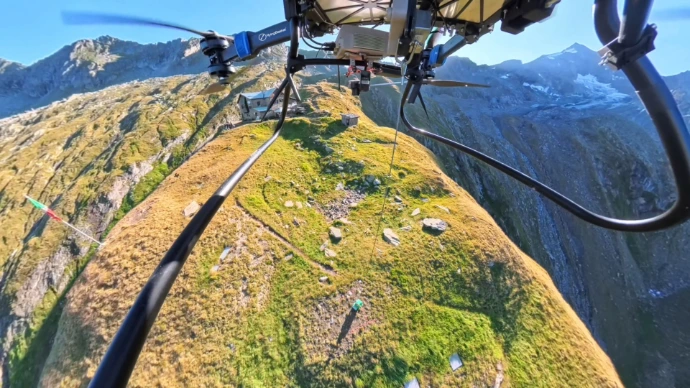
From the 2025 trial to everyday logistics
The step forward compared with the first trial is significant. In summer 2025, the project involved four mountain huts, with 21 flights and approximately one tonne of materials transported. One year later, the number of facilities has more than doubled and the volume of material handled is more than eight times that of the initial trial.
The objective of the project is precisely to assess the integration of cargo drones not only in individual demonstration missions, but in the real and recurring logistics of Alpine mountain huts.
For facilities that cannot be reached by roads or cable cars, resupply represents one of the main operational challenges. Fresh food, beverages and maintenance materials must be transported up to the huts, while waste and equipment have to make the journey in the opposite direction. Cargo drones introduce an additional tool that can be integrated with other transport systems depending on the characteristics and needs of each mountain hut.
“This project represents an important step for us in expanding the technical and regulatory boundaries of cargo-drone operations. By demonstrating these capabilities in real and complex operating environments, we are creating a clear path for our customers to use the same technology in similar scenarios. Our goal is to address the most complex aspects upfront, allowing customers to adopt an already validated solution and focus on their own operations,” says Moritz Moroder, CEO and co-founder of FlyingBasket.
“We transported everything from fresh bread and vegetables to dumplings and construction materials along routes with elevation differences of up to 1,500 metres, while also using the return flights to bring waste and equipment back down to the valley. At several mountain huts, we were able to make deliveries directly next to the kitchen entrance. Completing every scheduled operation over the course of the entire season demonstrates what this technology is already capable of today. The experience gained during this summer will feed directly into the further development of the FB3 for high-altitude operations and into FlyingBasket’s next generation of cargo drones.”
FlyingBasket was founded in South Tyrol in 2015 and today operates internationally in aerial logistics using cargo drones. The Alpine environment itself represents a setting in which the company can develop and test practical applications of its technology.
In this respect, the mountain-hut resupply project marks a further step forward: from demonstrating that a cargo drone can reach a mountain hut and transport significant loads, to assessing how it can become part of the hut’s regular logistics planning throughout an entire season.